
Blog
How to choose a theme agency WordPress developers trust

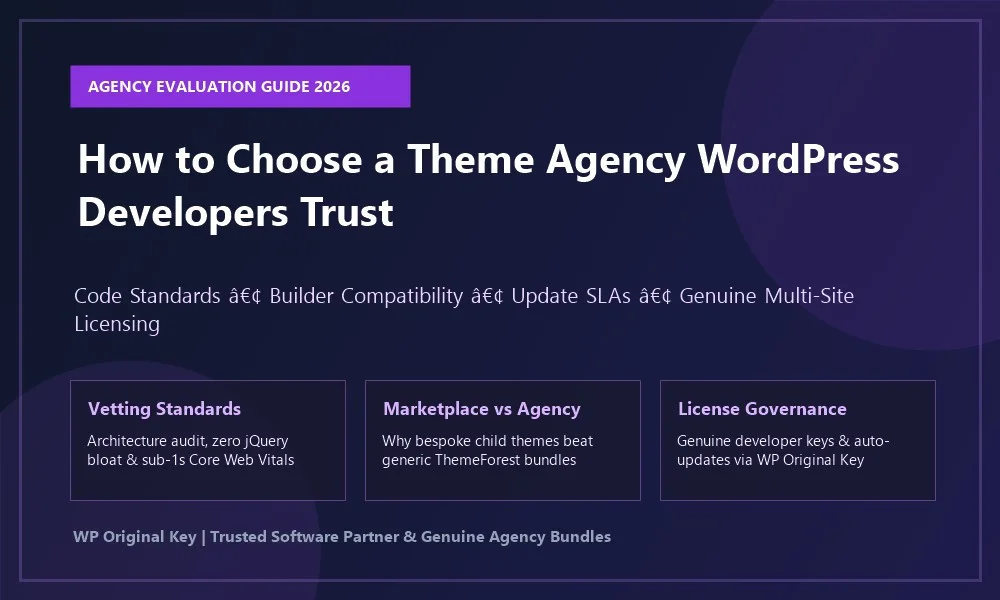
In an era where web performance, security compliance, and brand individuality dictate digital revenue, theme procurement is no longer a superficial styling choice. For growing businesses, design studios, and freelance developers, partnering with a specialized theme agency wordpress professionals trust can be the difference between a high-performing digital asset and an unmaintainable codebase riddled with technical debt. Whether you need an enterprise child theme built on lightweight frameworks, a multi-brand design system for WordPress Multisite, or reliable ongoing license management for dozens of client domains, vetting a WordPress theme agency requires rigorous scrutiny. In this comprehensive guide, we dissect what elite theme agencies do, provide an objective evaluation framework, contrast agency partnerships against marketplace purchases, and explain how authentic software licensing protects your agency’s reputation.
| Procurement Path | Upfront Investment | Performance & Code Quality | Maintenance & Updates | Best Use Case |
|---|---|---|---|---|
| Specialized Theme Agency | Moderate to High ($2,500 – $15,000+) | Bespoke, Clean Hooks, Sub-1s LCP | Dedicated SLA, staging verification, continuous updates | Scaling enterprises, B2B brands, multi-brand multisite networks |
| Commercial Marketplaces (ThemeForest) | Low ($49 – $79 one-off) | Often bloated (60+ scripts, multi-MB payloads) | Author-dependent; 6-month support caps, frequent abandonment | Low-budget personal blogs, disposable proof-of-concept projects |
| In-House Custom Engineering | High (Full developer salaries & dev cycles) | Variable based on internal developer skillset | 100% internal responsibility; ongoing overhead | Tech companies with dedicated in-house WordPress engineering teams |
| Framework Agency + Genuine Bundles | Cost-Effective ($200 – $600 bundle) | Engineered for Core Web Vitals (99/100) | Official automated dashboard updates via WP Original Key | Digital marketing agencies, freelance developers, growing studios |
What Does a WordPress Theme Agency Actually Do?
To many business owners, the term “theme agency” sounds interchangeable with a general web design firm. However, specialized WordPress theme development agencies operate on a much deeper architectural level. Rather than simply dragging and dropping visual elements on a screen, a dedicated theme agency delivers specialized engineering services:
- Custom Child Theme Architecture: Engineering clean, robust child themes built on industry-standard foundation frameworks (such as Astra Pro or GeneratePress). This isolates bespoke client styling and PHP hooks from core framework updates, guaranteeing that future theme updates never break production layouts.
- Modular Design Systems & Block Libraries: Constructing bespoke block patterns and design tokens (typography scales, fluid spacing, button hierarchies) compatible with the native WordPress Block Editor (Gutenberg) and Spectra Pro, or full visual site kits using Elementor Pro.
- Dynamic Data & CPT Wiring: Seamlessly integrating Custom Post Types (CPTs) with Advanced Custom Fields (ACF) or Pods, allowing non-technical marketing teams to populate case studies, team directories, and product catalogs effortlessly.
- Core Web Vitals & Performance Hardening: Auditing and optimizing asset delivery—eliminating render-blocking CSS, preloading key web fonts, utilizing modern WebP/AVIF formats, and stripping away unnecessary jQuery scripts.
- Multisite (WPMU) Governance: Architecting multi-tenant WordPress Multisite networks with centralized theme control, allowing corporate brands or educational institutions to spin up sub-brand sites in minutes.
- Lifecycle Maintenance & License Management: Managing software updates, staging-to-production synchronizations, and genuine developer license renewals across all active deployments.
When Should You Hire a Theme Agency vs Buying Off-the-Shelf?
Navigating the choice between hiring a dedicated theme agency and purchasing a commercial off-the-shelf theme from a marketplace depends entirely on your project’s technical complexity, performance thresholds, and scalability demands:
When to Hire a Specialized Theme Agency
- You Need Custom Enterprise Integrations: If your web portal connects directly to proprietary CRM platforms, bespoke ERP systems, or complex headless API endpoints, commercial themes will crumble under customization requests.
- Strict Brand Guidelines & Design Systems: When a corporate brand requires pixel-perfect adherence to custom Figma design systems with strict typography and fluid spacing tokens, trying to shoehorn an off-the-shelf marketplace theme into that mold causes endless CSS conflicts.
- High-Traffic Performance Requirements: If your business invests heavily in paid Google or Meta Ads, or generates millions of organic impressions, every 100 milliseconds of latency impacts revenue. A theme agency engineers lean, sub-50KB codebases that maximize Core Web Vitals scores.
- Multi-Brand Multisite Networks: Managing dozens of regional or franchise websites demands centralized child theme control and standardized global options.
When to Leverage Framework Themes with Agency Bundles
For mid-tier client budgets, freelance developers, and agile marketing agencies, spending $10,000+ on a custom bespoke agency build is often commercially unjustifiable. The modern alternative adopted by top developers is standardizing on battle-tested frameworks like Astra Pro paired with Astra Premium Starter Templates and genuine multi-site agency bundles from WP Original Key. This approach delivers 90% of custom agency benefits at a fraction of the cost.
The 4-Pillar Evaluation Framework: Choosing the Right Theme Agency
Before entering into a contractual agreement with a WordPress theme agency, technical leads and business owners must evaluate candidates across four non-negotiable operational pillars:
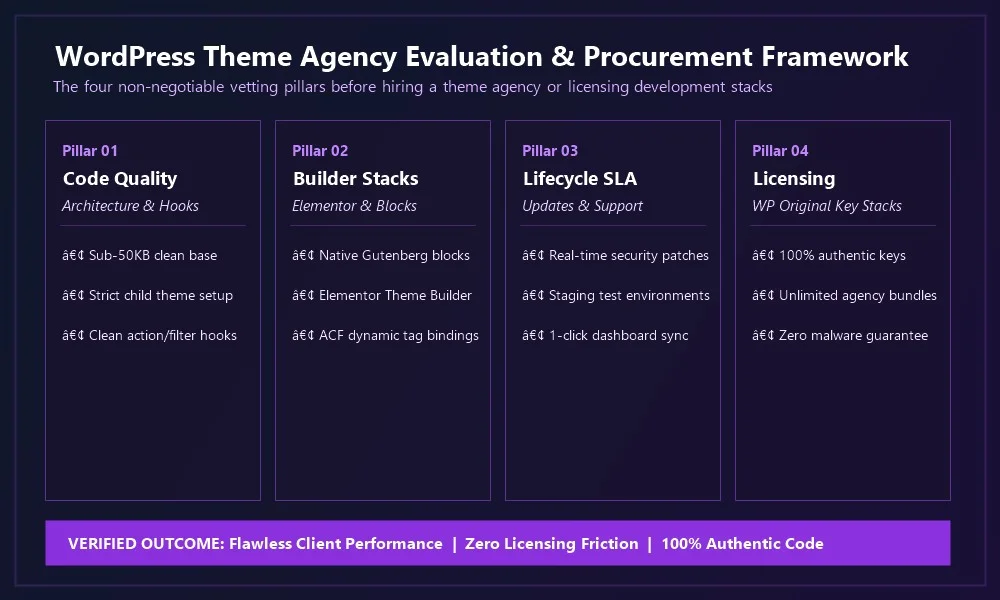
Let us analyze each evaluation pillar in detail:
Pillar 01: Code Architecture, Modularity & Clean Hooks
Examine the agency’s GitHub repositories or past theme code samples. A reputable WordPress theme agency follows strict WordPress Coding Standards (WPCS):
- Clean Hook Architecture: Theme templates should be driven by intuitive action and filter hooks (e.g.,
do_action('agency_before_header')) rather than messy, monolithic template files containing thousands of lines of intertwined HTML and PHP. - Zero jQuery Dependency: Modern WordPress themes should utilize vanilla JavaScript (ES6+) and native browser APIs, eliminating legacy jQuery libraries that delay DOM parsing.
- Modular CSS & CSS Variables: Global styling should be governed by semantic CSS custom properties (variables) rather than hardcoded inline style blocks or deeply nested CSS selectors with aggressive
!importantflags.
Pillar 02: Page Builder & Native Block Stack Compatibility
An elite theme agency never locks you into a proprietary, obscure visual builder that cannot be updated when WordPress core releases major updates. In 2026, a developer-trusted agency must demonstrate deep proficiency across two leading ecosystems:
- Elementor Pro Ecosystem: Mastery of Elementor Pro’s Theme Builder, custom dynamic tags, popup triggers, and developer addons such as Ultimate Addons for Elementor.
- Native Block Editor (Gutenberg) & Spectra Pro: The ability to deliver blazing-fast block themes utilizing native Gutenberg blocks and Spectra Pro components that achieve 100/100 Google PageSpeed scores on mobile devices.
Pillar 03: Lifecycle Maintenance, Staging Protocols & SLAs
Theme development does not end at site launch. WordPress core releases 3 major versions and dozens of maintenance updates every year. A credible agency must provide a documented Service Level Agreement (SLA) covering:
- Staging-First Testing: Verifying all theme and plugin updates on isolated staging subdomains before deploying changes to live production environments.
- Security Patch Velocity: Committing to patching newly disclosed vulnerabilities in theme components within 24 to 48 hours.
- PHP Version Compatibility: Ensuring themes are fully tested and compatible with modern PHP runtimes (PHP 8.2 and PHP 8.3+).
Pillar 04: Transparent License Governance & Software Authenticity
How an agency manages third-party software licensing is an immediate litmus test of their professionalism. When agencies build websites using premium plugins and themes, who owns the license keys? How are automated updates delivered? Demanding complete transparency regarding software provenance is essential to protect your organization.
The Hidden Dangers of Unverified Licensing in Agency Projects
Unfortunately, unscrupulous agencies and inexperienced freelancers frequently cut corners by installing “nulled,” cracked, or unlicenced GPL clones of premium plugins and themes across client websites. The consequences of this practice are catastrophic:
- Obfuscated Malware & Backdoors: Independent security audits reveal that over 80% of nulled WordPress themes contain malicious backdoors designed to inject pharmaceutical spam links, execute remote shell commands, or redirect mobile traffic to phishing portals.
- Disrupted Dashboard Auto-Updates: Without valid license key connections to official developer update repositories, plugins cannot update automatically. When a zero-day vulnerability emerges in WordPress core or WooCommerce, unlicenced client sites remain defenseless.
- Legal and Compliance Vulnerabilities: For commercial e-commerce businesses handling customer payment data, using unauthorized software breaches PCI-DSS standards and exposes the company to severe regulatory fines.
Why WP Original Key Is the Preferred Partner for Agencies & Developers
Whether you are an independent agency delivering websites for multiple commercial clients or a business owner evaluating your development stack, WP Original Key provides an indispensable software procurement foundation:
- 100% Authentic Developer Licences: Every license key sold on WP Original Key is verified directly against official developer servers. You receive clean, unaltered original code with zero security compromises.
- Unlimited-Site Agency Bundles: For agencies managing extensive client rosters, our unlimited-site packages for industry leaders like Astra Pro, Elementor Pro, and Schema Pro eliminate per-seat licensing caps and slash software overhead.
- Cost-Effective 1-Site Activation Service: Building a standalone client website? Our 1-site activation service lets you legally activate genuine premium licenses on individual client domains with official dashboard auto-updates, preserving healthy margins.
- Automated Dashboard Updates: Enjoy seamless, 1-click updates directly inside the WordPress admin dashboard, ensuring your client websites remain hardened against security exploits.
- Agency Deployment Assistance: Benefit from expert technical guidance on staging migrations, multisite activations, and developer hook configurations.
Agency Vetting Checklist: 10 Critical Questions to Ask
Before signing an agreement with any WordPress theme agency, require explicit answers to these 10 technical questions:
| # | Vetting Question | What You Want to Hear |
|---|---|---|
| 1 | What base framework do you build on? | Proven lightweight frameworks (Astra Pro, Hello Elementor, GeneratePress) or clean custom blank starters. |
| 2 | Do you build custom code directly in the parent theme? | “Never. We strictly isolate all bespoke styling, templates, and functions in a dedicated child theme.” |
| 3 | How do you guarantee Google Core Web Vitals compliance? | “We test for sub-1.0s LCP on mobile 4G networks, inline critical CSS, and eliminate render-blocking jQuery.” |
| 4 | Which page builders or block tools do you support? | “Elementor Pro with Theme Builder, or native Gutenberg with Spectra Pro blocks. Zero obscure proprietary builders.” |
| 5 | How are premium plugin and theme licenses handled? | “We provide authentic developer licenses with direct dashboard auto-updates, or transfer official licenses to your ownership.” |
| 6 | Do you support WordPress Multisite (WPMU) networks? | “Yes, we architect network-activated child themes with centralized CSS variable tokens for multi-brand rollouts.” |
| 7 | How do you test updates before pushing to production? | “All updates are tested on staging environments with database search-and-replace sanitization before production deployment.” |
| 8 | How do you handle SEO and structured data schema? | “We implement automated JSON-LD schemas using Schema Pro covering Organization, LocalBusiness, and Articles.” |
| 9 | Do you provide white-label administrative controls? | “Yes, we white-label theme controls and hide license settings tabs from client staff to prevent accidental deactivations.” |
| 10 | What is your ongoing support and security SLA? | “Documented SLA guaranteeing emergency vulnerability patches within 24–48 hours and quarterly compatibility audits.” |
Contractual Models: Fixed-Price Projects vs Ongoing Theme Retainers
When structuring an agreement with a WordPress theme agency, choosing the wrong engagement model can result in unexpected scope creep or abandoned software. Two primary commercial structures dominate the WordPress agency landscape:
1. Fixed-Price Milestone Contracts
Best suited for well-defined initial website builds or complete theme redesigns. The agency agrees to deliver specific milestone deliverables (Figma design system approval, staging environment prototype, QA cross-browser audit, and final production migration) for a set lump sum. Critical agency clause: Ensure the contract explicitly includes a 60-day post-launch warranty period covering bug fixes, browser updates, and core WordPress patch compatibility without additional billing.
2. Ongoing Theme Maintenance Retainers
For high-traffic e-commerce portals, news publishers, and SaaS platforms, theme code is living software that requires monthly stewardship. Typical theme retainers (ranging from $500 to $2,500/month) should cover:
- Monthly staging regression testing prior to major WordPress and WooCommerce core updates.
- Continuous Google Core Web Vitals monitoring and performance regression audits.
- Dedicated developer hours for incremental UI improvements, seasonal landing page templates, and conversion rate optimization (CRO) A/B testing.
- Active software license governance ensuring all developer licenses, security definitions, and API keys remain updated.
Monolithic PHP vs Headless WordPress: What Theme Agencies Recommend
One of the most consequential architectural discussions you will have with a modern WordPress theme agency revolves around monolithic vs headless infrastructure:
| Architectural Approach | Development Cost | Core Web Vitals Potential | Maintenance Complexity | Recommended Use Case |
|---|---|---|---|---|
| Monolithic Framework (Astra Pro / Hello + Elementor) | Low to Moderate | Outstanding (Sub-0.8s LCP on LiteSpeed) | Low; native WP admin dashboard, 1-click updates | 95% of business websites, D2C WooCommerce stores, lead-gen agencies |
| Block-Native FSE (Gutenberg + Spectra Pro) | Moderate | Pristine (Sub-0.6s LCP, zero builder bloat) | Minimal; pure WordPress core blocks, zero external runtime | High-traffic editorial publications, accessibility-focused government sites |
| Decoupled Headless (Next.js / Nuxt + WP REST API / GraphQL) | Very High ($20k – $80k+) | Near-instant client routing, but SSR caching complexity | Extreme; two distinct codebases, hosting costs on Vercel/AWS + WP | Large enterprise platforms, multi-channel mobile app + web publishing |
Unless your organization possesses a dedicated in-house DevOps team and complex cross-platform publishing needs, top agencies strongly advise against headless WordPress. A lean, framework-based monolithic build utilizing Astra Pro paired with Spectra Pro or Elementor Pro achieves equivalent sub-second Core Web Vitals at a fraction of the build cost and ongoing maintenance overhead.
Technical Portfolio Audit: How to Vet an Agency’s Live Work in 10 Minutes
Never rely solely on static screenshots in an agency’s portfolio. Execute this four-step technical audit on three live client websites developed by the agency:
1. Run Real-World Google PageSpeed Mobile Audits
Input the client URLs into Google PageSpeed Insights. Focus exclusively on the Mobile score. If an agency’s delivered websites score in the red (below 50) with an LCP exceeding 3.5 seconds on simulated 4G, their development team does not prioritize modern performance engineering.
2. Inspect the DOM for Asset Bloat
Open Chrome DevTools (F12) and inspect the Network tab on hard refresh (Ctrl+F5). Filter by JS and CSS:
- How many separate CSS files are loading? Quality agencies concatenate or modularize CSS to fewer than 10 requests.
- Are outdated jQuery slider libraries (Slick, Owl Carousel, Swiper) loading simultaneously? Multiple carousel libraries indicate uncoordinated, bloated development practices.
- Are images delivered in next-gen formats (WebP/AVIF) with explicit
widthandheightattributes to prevent layout shifts?
3. Check Schema Markup & Structured Data
Run the URLs through Google’s Rich Results Test tool. A competent WordPress agency will have properly configured JSON-LD schemas—including Organization, WebSite, BreadcrumbList, and appropriate content schemas like Product or Article using automation tools like Schema Pro.
4. Verify Source Code Licensing and Attribution
View the page source and search for theme folder paths (e.g., /wp-content/themes/). Look for a custom child theme directory (e.g., astra-child). Check that stylesheet headers properly credit your client or agency, and verify that no unlicenced or pirated script signatures appear in the assets directory.
Frequently Asked Questions (FAQ)
What is the difference between a theme agency and a freelance developer?
While talented freelancers can deliver great individual websites, a theme agency provides multi-disciplinary expertise—combining UI/UX designers, frontend performance engineers, accessibility auditors, and ongoing maintenance infrastructure with formalized SLAs.
Why shouldn’t businesses just buy a $59 theme from ThemeForest?
Marketplace themes are engineered to sell to the broadest possible audience, which often means packing dozens of unoptimized sliders, heavy shortcodes, and redundant JavaScript libraries into the codebase. This causes slow loading speeds, poor mobile Core Web Vitals, and severe plugin conflicts over time.
Can a theme agency build themes compatible with both Elementor and Gutenberg?
Yes. Many modern agencies build hybrid stacks: using Elementor Pro for marketing landing pages and complex visual headers, and Gutenberg with Spectra Pro for blazing-fast blog archives, resource libraries, and corporate case study pages.
How do agency bundles simplify multi-site license management?
Genuine agency bundles from WP Original Key provide centralized licensing across multiple domains or sub-sites, eliminating the administrative burden of tracking individual retail renewals while guaranteeing official automated dashboard updates.
Conclusion: Partner Wisely for Long-Term Digital Success
Selecting the right theme agency wordpress professionals rely on is a strategic investment in your organization’s digital scalability, security, and brand reputation. By holding agencies to strict standards regarding code quality, page builder compatibility, update SLAs, and authentic license management, you safeguard your business against technical obsolescence and cyber vulnerabilities.
Equip your agency or client projects with 100% authentic developer licenses, unlimited agency bundles, and reliable 1-site activation services by choosing WP Original Key as your trusted software partner.
Related Agency Resources: Explore our curated showcase of 10 WordPress Agency Templates to Speed Up Client Delivery, review top frameworks in Best Agency WP Themes for Scaling Client Projects, and discover scalability strategies in Top WordPress Themes for Agencies: Flexible, Fast & Scalable Picks.
Agency Stack Blueprint: Looking to standardize your internal development tools across multiple client sites? Explore our comprehensive breakdown of the Best WordPress Plugins and Themes for Agencies: Proven Picks for Client Projects.


